|
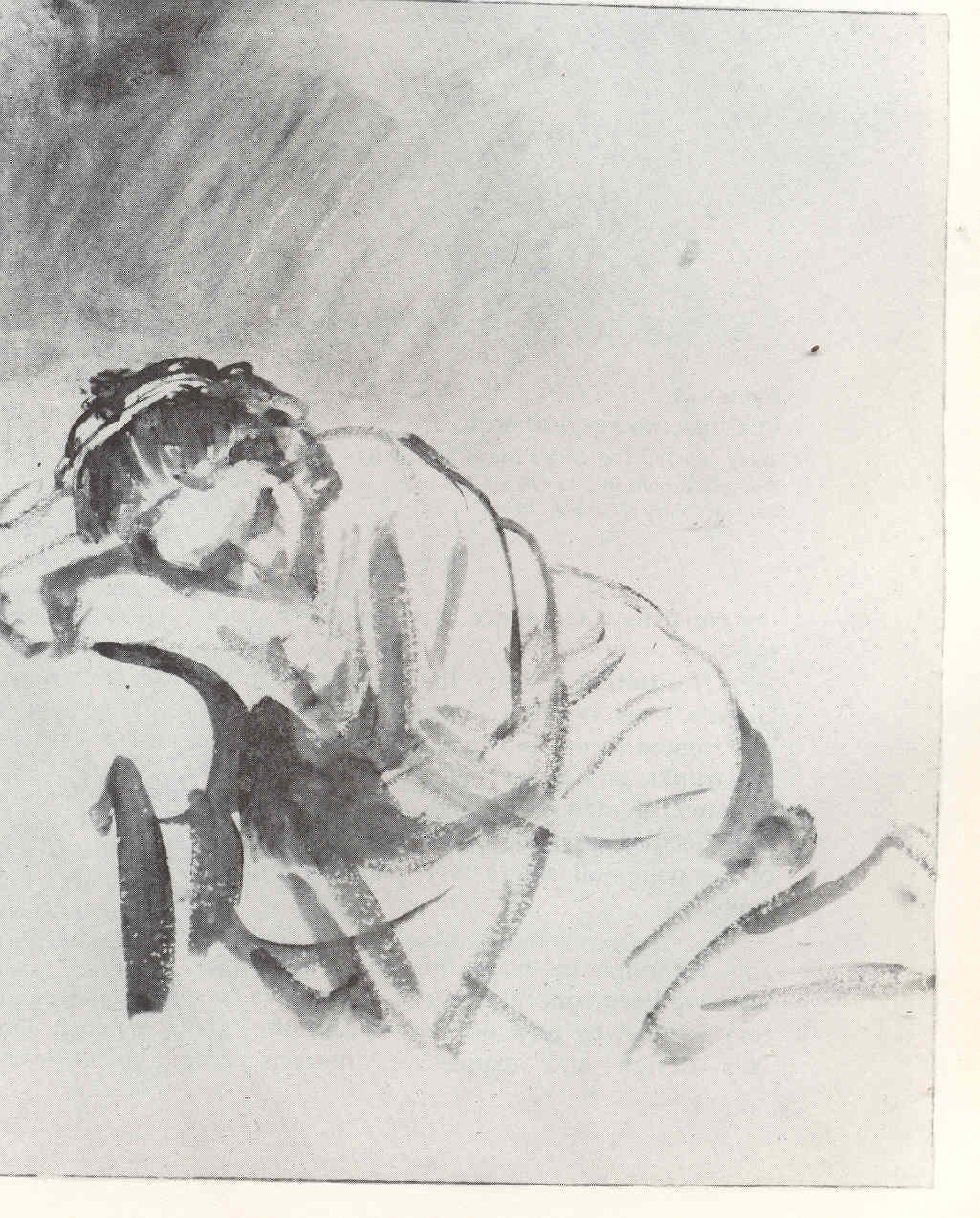
| The Life Model - white conte and charcoal on pre-tinted paper |
I have also noticed that students reasonably confident with a pencil, sometimes turn into nervous wrecks when asked to draw with pen and ink! The safety net of the eraser …gone! The resulting drawings are often stiff, showing the anxiety of the artist. So clearly…our thoughts and feelings, as well as our skills, are conveyed to the world through our drawings.
It is interesting to realise that unlike our handwriting, which we take for granted and which rarely changes in style, all drawn lines have expressive qualities, and the more we explore the differing characteristics of the lines we create, the more we expand our artistic vocabulary and move beyond our natural inclination to draw everything in the same way .

Of course, it is appropriate to spend time making drawings which are purely observational – exploring our subject carefully, constructing the form as accurately as possible, getting the fundamentals of proportion, scale, perspective, direction etc right. This can be taught, and learned, it becomes a valuable skill. Here is a drawing of a skull I did when I was a student. It shows evidence of strong observation,it was clearly the result of slow, careful execution, it is competent - but somewhat bland and lifeless ....sorry, awful pun there ! :)

Take a look at this selection of lines below. And think of the adjectives we could apply to them. Can you “see” any of these words?
nervous : angry : happy : free : quiet : excited : calm : dancing : vigorous ; graceful : confident : hesitant : joyful

The basics of good proportions, form and structure, still need to be present in your drawings, but I urge you, at the same time,to consider, albeit gradually to begin with, the use of line variety for expressive and emotional reasons, to emphasise some of the abstract qualities of your subject. Lines can flow slowly or rapidly to express varying types of movement, they can be heavy or positive for emphasis and drama, they can express tone and weight, they can be soft and sensitive and even by their absence, can suggest light - or lack of it, as in the life model drawing at the top of this blog. you may find, as you become sensitive to this aspect of drawing, that you begin to produce drawings which are so much more interesting and telling, than those created purely to be accurate.